Thursday, January 5, 2012

Climate Stuff My Friends Talk About! Edition 1.0


Climate Stuff My Friends Talk About!


The 2011 Climate B.S.* of the Year Awards

Posted: 05 Jan 2012 09:17 AM PST

[*B.S. means "Bad Science." What did you think it meant?]

http://thepoliticalcarnival.net/wp-content/uploads/2011/12/badscience1.gif

by Peter Gleick

The Earth's climate continued to change during 2011 – a year in which unprecedented combinations of extreme weather events killed people and damaged property around the world. The scientific evidence for the accelerating human influence on climate further strengthened, as it has for decades now. Yet on the policy front, once again, national leaders did little to stem the growing emissions of greenhouse gases or to help societies prepare for increasingly severe consequences of climate changes, including rising temperatures, changing rainfall patterns, rising sea-levels, loss of snowpack and glaciers, disappearance of Arctic sea ice, and much more.

Why the failure to act? In part because climate change is a truly difficult challenge. But in part because of a concerted, well-funded, and aggressive anti-science campaign by climate change deniers and contrarians. These are mostly groups focused on protecting narrow financial interests, ideologues fearful of any government regulation, or scientific contrarians who cling to outdated, long-refuted interpretations of science. While much of the opposition to addressing the issue of climate change is political, it often hides behind pseudo-scientific claims, with persistent efforts to intentionally mislead the public and policymakers with bad science about climate change. Much of this effort is based on intentional falsehoods, misrepresentations, inflated uncertainties, or pure and utter B.S. – the same tactics that delayed efforts to tackle tobacco's health risks long after the science was understood (as documented in Naomi Oreskes and Erik Conway's book, Merchants of Doubt).

Last year, we issued the first ever "Climate B.S.* of the Year Awards." I am now pleased to present the 2nd Annual (2011) Climate B.S.* of the Year Awards. In preparing the 2011 list of nominees, suggestions were received from around the world and a panel of reviewers — all climate scientists or climate communicators — waded through them. We present here the top nominees and the winner of the 2011 Climate B.S.* of the Year Awards.

The 2011 Winner:

Climate B.S.* from all of the Republican candidates for President of the United States

http://i20.photobucket.com/albums/b231/mumbly_joe/cementshoes1.gifIs it really necessary to be anti-science in general, and anti-climate science in particular, in order to be nominated to lead the Republican Party in the United States? Apparently, yes, at least in the minds of the Republican presidential candidates or their advisors. These candidates can be split into three groups: those ignorant or uninterested in science and its role in informing policy; those who intentionally distort science because it conflicts with deeply held political or religious ideology; and those who blow with the wind, giving their allegiance to whatever ideology seems most expedient at any given moment. There is some overlap, of course: some candidates, such as Rick Perry, have been in all three groups at various times. The third group includes candidates who have at one time or another held positions more or less consistent with scientific understanding but who in 2011 adopted anti-scientific positions during their primary campaigns. For example, Gingrich, Romney, and Huntsman, at some point in the past, all expressed at least a partial understanding about the reality and seriousness of human-caused climate change. Yet all three have now retreated from the scientific evidence to faulty but ideological safe positions demanded by the conservative wing of the Republican Party. In October, Romney caved in to conservative pressure and changed his stance on the issue. Just days ago, after pressure from anti-climate-science activists, Gingrich cut a chapter on climate science from a book of environmental essays he had agreed to produce. Ironically, that chapter was to have been written by an atmospheric scientist (Katharine Hayhoe, director of the Climate Science Center at Texas Tech University) who happens to be an evangelical and speaks regularly to conservative groups. She was also targeted by these activists for personal abuse – a tactic often pursued by climate deniers and contrarians.  (For a few of the craziest things the top GOP candidates have said on climate change, see Joe Romm's recent essay at Think Progress.)

In short, the choice among the Republican candidates on the issue of climate change is scientific ignorance, disdain for science, blatant misrepresentation of facts, or naked political expediency, any one of which would make the Republican candidates strong contenders for the 2011 Climate B.S. Award. Combined? They win hands down.

[For comparison, while the Obama Administration has made little progress (and some would argue insufficient effort) on climate change, the President's stated position on climate change is clear and in line with scientific evidence. And here is his unequivocal comment on scientific integrity:

"Today, more than ever before, science holds the key to our survival as a planet and our security and prosperity as a nation. It's time we once again put science at the top of our agenda and worked to restore America's place as the world's leader in science and technology…the truth is that promoting science isn't just about providing resources. It's about protecting free and open inquiry. It's about ensuring that facts and evidence are never twisted or obscured by politics or ideology. It's about listening to what our scientists have to say, even when it's inconvenient. Especially when it's inconvenient. Because the highest purpose of science is the search for knowledge, truth, and a greater understanding of the world around us…" http://www.youtube.com/watch?v=kFsB1Jk1OQ0]

Second Place: Disinformation from Fox News and Murdoch's News Corporation

In this year's competition, we award Fox News second place – up from their fifth place finish last year. This year, the award is extended to the entire News Corporation empire of Rupert Murdoch because of its apparent efforts to synchronize anti-climate science reporting among the different Murdoch outlets in the UK, the U.S., and Australia. Among the bad climate science promoted by Fox News is that snowy weather disproves global warming (while ignoring or inaccurately reporting record high temperatures recorded around the world); biased and misleading reporting about the content of emails stolen from climate scientists; incorrect claims that El NiƱos are responsible for global warming; and inaccurate reporting about fundamental scientific principles.

Other Murdoch empire assaults on climate science?

The editorial page editors of the Wall Street Journal routinely dismiss or ignore all climate change science. Glenn Beck incorrectly tells viewers that there has been no warming in the past decade – the hottest decade in over a century. Ben Webster of the Times of London has produced a long series of inaccurate pieces on the Intergovernmental Panel on Climate Change (IPCC), regularly amplified by Fox News. Sean Hannity says "global warming doesn't exist." Fox Washington managing editor Bill Sammon officially directed his journalists to cast doubt on climate science. Brian Kilmeade, of Fox & Friends, joked, "Sorry global warming people, we have too many polar bears." And of course, Bill O'Reilly has stated incorrectly, "For every scientist who says there is [climate change], there's one that says there isn't." [Thanks to MediaMatters for tracking these statements.] As a 2011 story in Rolling Stone noted, "[n]o one does more to spread dangerous disinformation about global warming than Murdoch."

In an analysis of network news reporting on climate change, Feldman, Maibach, Roser-Renouf, and Leiserowitz concluded that Fox News is consistently the most dismissive about climate change and is highly biased toward choosing climate change doubters to interview. Nearly half of their guests dismiss climate change compared to 9 and 15% at CNN and MSNBC. In the scientific community, 97 to 98% of climate scientists accept human-caused climate change. This misinformation has an effect: a study from Stanford University shows that Fox viewers are far more likely to be fundamentally misinformed about climate change than others. In short, frequent exposure to Murdoch news reporting can be hazardous to your understanding and knowledge of the real world.

Third Place: Spencer, Braswell, and Christy for their lack of climate "sensitivity"

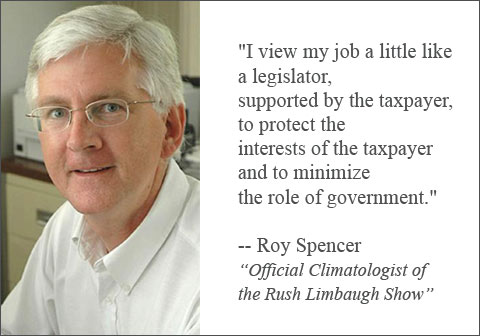
Third place goes to Roy Spencer and William (Danny) Braswell for a research paper on climate sensitivity, and John Christy, for an astounding piece of misleading testimony at a Congressional climate change hearing. Both the paper and the testimony received lavish attention from climate contrarians (including an especially absurd piece from the Heartland Institute, published as a Forbes blog post) and both were extensively and surgically debunked by the scientific community. The key scientific issue here is "climate sensitivity" – how much the climate will change in response to natural and human influences. Spencer and Christy have argued for many years that the sensitivity of the climate is low, and their science has been constantly, regularly, and convincingly disputed. In 2011, Spencer and Braswell published a paper in the journal Remote Sensing that turned out to contain serious scientific errors according to experts working in this field. What makes a scientific paper 'bad'?  A bad paper makes substantive errors in the analysis, misrepresents or ignores conflicting data or conflicting research, fails to address alternative explanations, or draws conclusions logically inconsistent with the results. Critics argued that this paper suffered from all of these problems (see the Dessler analysis, a video describing the flaws, the Trenberth and Fasullo assessment, and a formal response published in Remote Sensing).

In an astounding event, Wolfgang Wagner, the editor of the journal that published the Spencer and Braswell paper, resigned for having failed to spot the paper's scientific flaws during peer review. As he stated in his resignation letter:

"After having become aware of the situation, and studying the various pro and contra arguments, I agree with the critics of the paper. Therefore, I would like to take the responsibility for this editorial decision and, as a result, step down as Editor-in-Chief of the journal Remote Sensing… With this step I would also like to personally protest against how the authors and like-minded climate sceptics have much exaggerated the paper's conclusions in public statements."

Similar flawed scientific arguments about climate sensitivity made in the paper were repeated, along with other incorrect or misleading arguments about climate science, in testimony of John Christy at the March 8, 2011 hearing of the U.S. House Subcommittee on Energy and Power, called by the Republicans to try to prevent the EPA from regulating greenhouse gas pollution. In Christy's testimony, he repeats arguments that many in the climate science community consider to be myths and errors, including continued reliance on a scientific article that other climate scientists have argued is flawed. Here is a comprehensive summary of Christy's errors. Finally, two new studies (here and upcoming by Po-Chedley and Fu in the Journal of Atmospheric and Oceanic Technology) also identify analytical errors in papers and pronouncements by Spencer and Christy – adding to a long line of errors that have required corrections to their work for more than a decade.

Fourth Place: The Koch Brothers for funding the promotion of bad climate science

Fourth place goes to fossil-fuel billionaires Charles and David Koch of Koch Industries, Inc., who provide substantial funding to groups and politicians who deny the science of climate change. As noted in a New Yorker story, from 2005 to 2008, the Kochs vastly outspent even ExxonMobil in funding a network of anti-climate science groups. A partial list of groups funded by the Koch brothers includes a veritable who's who of groups that put out misleading science or tout bad science on climate change. Tim Phillips, president of the super-PAC funded by the Kochs, Americans for Prosperity, brags outright about their political influence on Republican candidates: "If you look at where the situation was three years ago and where it is today, there's been a dramatic turnaround. Most of these candidates have figured out that the science has become political. We've made great headway." This may be good for their business, but it is bad for America, bad for science, and bad for our climate.

Fifth Place: Anthony Watts for his BEST, and worst, climate hypocrisy

Anthony Watts runs a blog popular with the anti-climate science crowd. He ran into a brick wall this year when he voiced support for an ongoing climate study (the "Berkeley Earth Surface Temperature" or "BEST" study) that he thought would prove his anti-warming beliefs to be right because it was being done by someone he thought was in his camp ("… I'm prepared to accept whatever result they produce, even if it proves my premise wrong."). Unfortunately for him, that study proved his premise wrong and instead reconfirmed what climate scientists have been saying for decades: the Earth's surface is warming and at just the rate that numerous previous studies had shown. Watts then proceeded to tear down the paper, ostensibly because it hadn't been through peer-review, despite the fact that Watts, his guest posters, and commenters routinely and consistently produce or cite non-peer-reviewed science (often later shown to be wrong) to support their claims.

Runners Up: Other Noteworthy Climate B.S. of 2011

Some voters felt that the following entries submitted for the 2011 Climate B.S. competition deserve recognition though they win no awards from us.

Harrison Schmitt and the Heartland Institute for "Arcticgate"

As the Arctic ice disappears before our eyes, we must call attention to former Senator Harrison Schmitt's refusal to correct persistent errors and "cherry picking" of data in denying the disappearance of Arctic sea ice, and for the Heartland Institute's promulgation of – and refusal to correct – those errors when they were uncovered.

Rush Limbaugh for his consistent falsehoods about climate science

We would acknowledge Rush Limbaugh for his blatant and stunningly high level of climate B.S., but he has already been awarded the "Climate Change Misinformer of the Year" award at MediaMatters.org.

Steve McIntyre

And finally, the "dishonorable" mention of the year goes to Steve McIntyre for his despicable smear of climate scientist Dr. Michael Mann of Penn State University (and to Anthony Watts for amplifying that smear) by drawing a parallel between the Penn State pedophilia investigation and their separate scientific investigation of questions about climate research (in which Professor Mann has been completely and repeatedly exonerated). Joe Romm discusses this disgusting case here.

The 2011 Climate B.S. of the Year Award was prepared by Peter Gleick with an independent group of climate scientists and communicators serving as nominators, reviewer, and voters. Thanks to all who participated this year. See you next year.

– Dr. Peter H. Gleick is co-founder and President of the Pacific Institute in Oakland, California. He is an internationally recognized climate and water expert and works at the intersection of science and policy, including issues related to the integrity of science. Dr. Gleick received a B.S. from Yale University in Engineering and Applied Science, and an M.S. and Ph.D. from the Energy and Resources Group of the University of California, Berkeley. He is the recipient of numerous awards for his work, among them the prestigious MacArthur "genius" Fellowship in 2003. He was elected to the U.S. National Academy of Sciences in 2006.

20 Ideas for Job Creation: Keep Focused on Clean Energy

Posted: 05 Jan 2012 08:30 AM PST

With the word "jobs" on the lips of every policymaker in the country, here are some of the best ideas for creating well-paying employment opportunities for a wide range of people throughout the U.S.

Forget a top-10 list, we're jumping straight to a top-20 list for job creation in 2012 – and clean energy, environmental standards and efficiency dominate the list. This list was not compiled by Climate Progress. It was compiled by the editorial team at the Center for American Progress. Many of the ideas are extensions of CAP's "Meeting the Jobs Challenge" initiative launched in 2009. — Stephen Lacey

20 Ways to Create Jobs

1. Upgrade our nation's roads, bridges, and other basic infrastructure: 18,000 new jobs for every $1 billion invested.

2. Launch a rehab-to-rent program to turn tens of thousands of government-owned foreclosed homes into affordable rental housing, stabilize neighborhoods, and put construction workers back on the job: 20,000 new jobs a year.

3. Implement new EPA rules governing toxic emissions from power plants: 40,000 new direct jobs.

4. Protect health care reform, which will reduce health insurance premiums, expand coverage, and create jobs: 250,000 to 400,000 new jobs a year for the next decade.

5. Retrofit for energy efficiency just 40 percent of the nation's residential and commercial building stock and unleash massive demand for domestic labor: more than 625,000 new jobs over a decade.

6. Extend emergency unemployment benefits to long-term unemployed workers hurt by the economic downturn: more than 700,000 jobs.

7. Expand the payroll tax cut for employees and extend it to employers through 2012: more than 1 million jobs.

8. Extend national service programs to provide young people with full-time positions in AmeriCorps, VISTA, YouthBuild, and the youth service and conservation corps: 60,000 new jobs.

9. Pass Home Star, Building Star, and Rural Star legislation to make homes and buildings energy efficient while supporting the hard-hit construction industry: 250,000 new jobs a year.

10. Reduce the nation's dropout rate by half to add $9.6 billion in economic growth and $713 million in increased tax revenue: 54,000 new jobs.

11. Convert offshore wind power to electricity: 20 direct jobs for each megawatt produced in the United States.

12. Protect funding for community health centers over the next five years to provide health and related services at clinics and in the local business communities: 300,000 new jobs.

13. Protect the National Park Service from budget cuts, corporate interests, and antigovernment rhetoric to support jobs in outdoor recreation across the country: 247,000 jobs.

14. Increase freight rail capital investment: 7,800 direct and indirect jobs for every $1 billion invested.

15. Create a $10 billion trial-employment program with potential to help an estimated 1 million small businesses and startups hire long-term unemployed workers: 2 million new job opportunities.

16. Construct new power transmission lines to reshape our electric transmission grid and create new employment: Generating 20 percent of power with wind can create more than 500,000 jobs.

17. Expand the federal "jobs accelerator" program: Just $200 million in funding could result in 1,800 new businesses employing thousands of workers.

18. Reject a federal proposal to mandate employer use of the E-Verify eligibility verification system and protect 770,000 American jobs.

19. Revamp small-business financial assistance programs to better serve the needs of innovative, high-growth potential startup firms.

20. Create a "common application" for federal programs that foster the growth of small businesses.

Related Post:

Rush Limbaugh Serving as De Facto Editor of Gingrich Eco-Book

Posted: 05 Jan 2012 07:30 AM PST

by Jocelyn Fong, cross-posted from Media Matters

Republican presidential candidate Newt Gingrich has canceled the climate change chapter in his upcoming book of environmental essays after Rush Limbaugh and other commentators targeted its author, atmospheric scientist Katharine Hayhoe.

At a recent campaign event, Gingrich told a woman he had cut the climate change section after she expressed concerns about it, citing what she heard from "Rush." "That's not going to be in the book. We didn't know that they were doing that and we told them to kill it," Gingrich says in the video provided by National Journal. The woman replies, "That sounds like a good idea because I thought, why would you want to have somebody like that in there."

By "somebody like that," she was referring to a scientist who, like the vast majority of climatologists, will tell you that human activities are driving climate change. Gingrich's comments came as a surprise to Hayhoe, who said on Twitter that she spent "100+ unpaid hrs" on the project. According to emails reported by the Los Angeles Times, Hayhoe was asked in 2007 to write "a good opening chapter that lays out the facts on global climate change," including "a sense of what needs to happen." She said via email that her chapter did not include specific policy prescriptions. Gingrich's collaborator Terry Maple told the Times that the book will probably be released in 2013.

Hayhoe, an Evangelical Christian who often speaks about climate change to faith-based communities, has noted in the past that "there is a very intelligent, well-planned effort to deliberately try to muddy the waters on this issue." This month, she became the target of that very cohort of activists and commentators.

Following the December 8 L.A. Times article identifying Hayhoe as a contributor to Gingrich's book, Marc Morano, former spokesman for Senator Inhofe, spent the past month attacking her on his blog, Climate Depot. Morano also encouraged his readers to contact Hayhoe directly by repeatedly posting her email address.

Chris Horner's American Tradition Institute also filed a request with Hayhoe's employer, Texas Tech University, requesting any emails she sent or received about the book. ATI's tactics of targeting individual scientists previously prompted a formal condemnation from the American Association for the Advancement of Science, one of the country's leading scientific associations. The AAAS resolution criticizing the intimidation of scientists was introduced by Raymond Orbach, who served as a top Energy Department official under George W. Bush.

Morano got a boost from his former boss Rush Limbaugh on December 19, when Limbaugh told his radio audience that "Newt's new book has a chapter written by a babe named Hayhoe," who "believes in man-made global warming." (Limbaugh also uses the word "babe" to undermine women who work in government and media.)

Morano later celebrated the news that Gingrich had scrapped Hayhoe's chapter on climate change with the following headline:

Climate Depot:

The fiasco attests to the influence wielded over the Republican Party by right-wing media and others who reject the scientific consensus that manmade climate change demands our attention. Morano previously said Republican candidates "can believe in the science of global warming … if you keep your mouth shut about it and you advocate no quote-unquote solution to the problem."

Limbaugh, who we selected as the 2011 Climate Change Misinformer of the Year, has also established a climate denial litmus test, saying "bye, bye, nomination" after Mitt Romney acknowledged the human contribution to climate change. Romney subsequently tweaked his position.

Limbaugh also criticized Gingrich in November for saying, "I actually don't know whether global warming is occurring. The vast majority of the National Academy of Science says it is." Even though Gingrich quickly added, "Science is not actually voted on," Limbaugh responded "Newt, Newt, Newt, Newt. No! … There isn't any global warming." The news that Gingrich will avoid the topic of climate change in his book is particularly clarifying in light of where he stood a few years ago. Consider these comments from a November 2007 interview with the New York Times:

GINGRICH: I'm trying to say to the Right the environment's too important to neglect. The issues are too serious to walk away from and therefore you've got to drop just screaming "No" and you got to show us what the right solutions are from your standpoint.

For her part, Hayhoe says via email that despite "a marked upswing in the quantity and virulence of the hate mail and other forms of attack" since the summer, she continues to speak publicly about climate science because "there is important information people need to know, in order to make informed decisions." Otherwise, she said, she'd be a bit like a doctor who withheld bad news from a patient for fear of their reaction.

Jocelyn Fong is a researcher with Media Matters for America. This piece was originally published at Media Matters.

Big Oil's "Vote 4 Energy" PR Blitz Funded by American Families

Posted: 05 Jan 2012 06:36 AM PST

A caption from a Greenpeace ad released yesterday mocking Big Oil's new campaign

by Daniel J. Weiss and Jackie Weidman

The American Petroleum Institute – the lobbying arm of big oil and gas companies – yesterday announced its "Vote 4 Energy" campaign that will promote its policy agenda in key electoral states including Ohio, Pennsylvania and Virginia.  This campaign will more loudly promote the Big Oil agenda of more drilling, fewer safe guards, and retention of Big Oil tax breaks.

API's members, including the five largest public oil companies which could earn record profits in 2011, will likely provide major funds this program. These funds come from profits that are due to record high oil prices, which led American families to pay the highest average annual gasoline price ever.

These high prices pose real economic harm to Americans. According to the Associated Press:

"The typical American household will have spent $4,155 filling up this year, a record. That is 8.4 percent of what the median family takes in, the highest share since 1981."

Adding insult to injury, American taxpayers provide $4 billion in annual tax breaks to Big Oil companies, half of which go the big five.

The bottom line: Americans are subsidizing big oil's campaign that is designed to convince them to support policies that will ultimately increase oil company profits — at the public's expense.

High oil and gasoline prices and oil profits go hand-in-hand.  In 2011, "real" oil prices averaged $103 per barrel – the highest since 1864 back when Abraham Lincoln was president. The annual average real gasoline prices were the highest since 1949, the first year of Department of Energy data.  These record prices explain why the world's five largest public oil companies – BP, Chevron, ConocoPhillips, ExxonMobil, and Royal Dutch Shell – made over $100 billion in the first three quarters of 2011.  To make matters worse, instead of investing in clean energy, companies like Exxon spent up to half of their profits each quarter repurchasing their own stock to enrich board members and investors.  They could exceed $130 billion in profits for the entire 2011 when the fourth quarter profit numbers are released later this month.

Although API won't reveal its ad campaign cost, API President and CEO Jack Gerard said on Wednesday that the group is spending "a significant amount" to ensure that oil and gas drilling is the main issue of the 2012 campaign.  API intends to litter swing states with advertisements designed to promote its "drill, baby, drill" message, along with the approval of the Keystone XL pipeline for tar sands oil.  Gerard explicitly threatened the president on the latter issue, noting that if he does not approve the Keystone XL pipeline, he will face "huge political consequences."

Another major component of Big Oil's multi-million dollar pressure campaign will likely include attempts to convince Americans that health protection and environmental safeguards stymie U.S. oil production.  Gerard falsely accuses an unidentified "some" for supporting such rules.

"Some seem to be opposed to any oil and natural gas development."

"We see it in the onslaught of regulations from a host of federal agencies that threatens to impose unnecessary costs on businesses struggling to survive."

These nameless false attacks are really aimed at the Obama administration, but Gerard lacks the courage to say so.  This baseless assault ignores the evidence that shows crude oil production has been on the rise since Obama took office at the same time new pollution reductions were adopted.

For the first time in over a decade, the U.S. produces more than half of its oil – imports are below 50 percent.  Last year, API reported that the number of new drilling rigs increased by 28 percent.  The Wall Street Journal reported in late August a staggering jump in total U.S. drill rigs since Obama took office.  They noted a "huge surge in U.S. oil drilling, up nearly 60% in the past year and the highest total since at least 1987, when oil services company  Baker Hughes Inc. began keeping track."

API also released a study today falsely claiming that the temporary post-BP disaster deep water drilling moratorium in the Gulf of Mexico cost 90,000 jobs.  In fact, a Republican witness at an October 2011 House Natural Resources Committee hearing testified that the moratorium lead to only 11,500 fewer temporary jobs over two years.  While job losses are unfortunate, the actual reduction is nearly 90 percent less than API claims.

Actually, over the past five years, the big five oil companies have shed U.S. employees even while they made gigantic profits.  House Natural Resources Committee Democrats determined that:

"Despite generating $546 billion in profits between 2005 and 2010, ExxonMobil, Chevron, Shell, and BP combined to reduce their U.S. workforce by 11,200 employees over that time."

API also ignores the economic hardship for people make their living on or near the water if there were another catastrophic oil blow out.   After the BP disaster, overall tourism and consumer spending in the Gulf states' coastal economies fell by 40 percent in June 2010.  The temporary moratorium – since lifted – was designed to prevent another such economic calamity.

When asked about whether API is satisfied where the administration is heading, Gerard expressed disappointment in the number of current projects:

"The lease sales as part of the current administration's five-year plan put forward by the administration limits the activity to the Western and Central Gulf.  The areas where we have been producing for 65 years… the places we need to look are places we haven't been in the past."

Despite Big Oil's repeated complaints about the reduction in offshore oil drilling due to the Obama administration, the Associated Press determined that "by early 2012, the Gulf will have more rigs designed to drill in its 'deep water'… than before the spill."

At yesterday's press event, Gerard dodged a question on how the U.S. became a net exporter of oil and gas in what the API claims is an "overly regulated political environment."  In fact, the U.S. exported 848 million barrels of oil worth $73.4 billion, and only imported 750 million barrels through October 2011, according to the Wall Street Journal.

While hitting families hard in their pocket books, the oil industry does little to develop the cleaner fuels of the future.  Gerard purported to support oil industry innovation and creativity, noting:

"We believe what the American voters are saying is give us leadership.  Give us leaders who share our vision of a strong and prosperous nation, which can be built on creativity and innovation specifically in the energy sector."

Yet the Natural Resources Defense Council found that in the past five years the oil industry has spent a meager $4 billion on renewable fuel investments, compared to the $2.1 trillion in capital expenditures to find and produce more oil.  For every dollar the oil industry spent on oil exploration and production, less than half a penny was spent on the clean renewable fuels of the future.

The Vote 4 Energy ads that will run alongside CNN election coverage claim to be testimonials from American citizens that support the oil industry's agenda.  In fact, participants were fed lines and "any deviation from [API's] script was refused."

Gerard's most laughable claim is that the " 'Vote 4 Energy' is not about a political party — it's not even about the candidates."  In fact, Big Oil heavily favors Republicans over Democrats.  Opensecrets.org determined that during the last election cycle, Big Oil spending favored Republicans by nearly 4 to 1.  The 2011-12 big oil contributions are even more tilted to the Republicans, by nearly 10 to 1.  It's easy to imagine that the "Vote 4 Energy" campaign will reflect Big Oil's partisan leanings.

API's "Vote 4 Energy" pressure campaign simply promotes the expansion of our oil-dependent status quo policies despite their national security, economic and environmental costs. This agenda would fuel even greater profits for Big Oil companies, while removing even more cash from our wallet — the same wallets feeding the enormous profits that will pay for this campaign.  API's "new" 2012 campaign won't be new at all; rather, it will be more of the same – gouging American families at the pump while lining the coffers of some of the wealthiest corporations in the world.

– Daniel J. Weiss is a senior fellow with the Center for American Progress Action Fund; Jackie Weidman is a special assistant for energy policy at the Center for American Progress.

January 5 News: Lack of Sea Ice Could Be Causing More Seal Deaths, Say Researchers

Posted: 05 Jan 2012 05:21 AM PST

Other stories below: Debate flares on U.S. natural gas exports; Insurance payouts point to climate change

AP photo: Clarke Canfield

Lack of ice could be causing more seal deaths: study

A new scientific study suggests harp seals in the North Atlantic are dying at high rates because of warming waters and a steady decline of sea ice in their traditional breeding grounds.

The research by scientists at Duke University in North Carolina tracked the decrease of sea ice due to global warming and the mortality of harp seals from 1992 to 2010.

David Johnston, a marine scientist who co-wrote the report, said it's the first study to show that seasonal ice cover in the four seal breeding areas of North America has receded by as much as six per cent per decade.

"There has been a string of light ice years recently and we're starting to be concerned that if ice continues to decline, this might have longer-term effects on the harp seal population," Johnston said from his office in Beaufort, N.C.

"I'm concerned that these animals are in for a tough road with what we're seeing with climate change."

Should the U.S. export its natural gas? A debate flares

Last year, fuel was America's #1 export. But not everyone's so keen on watching the United States ship out all that energy to the rest of the world. Case in point: On Wednesday, Rep. Edward Markey (D-Mass.) fired off a letter to Energy Secretary Steven Chu asking him whether it was really such a swell idea for the United States to be exporting its newly abundant natural gas resources all over the globe. Some experts, after all, have raised concerns that such exports could have unexpected downsides.

On the surface, there's an alluring logic in exporting natural gas. The United States has been flooded with cheap gas thanks to its newly exploitable (and potentially large) shale resources. And gas prices are higher in many other countries. So why not ramp up exports, turn a profit, and reap the gains from trade? That explains why various producers are asking the Energy Department to green-light new export facilities, such as Cheniere Energy's just-okayed Sabine Pass Liquefaction terminal in Cameron Parish, La., which will ship out two billion cubic feet of gas per day by 2015. Seven more projects are awaiting approval.

Insurance payouts point to climate change

Natural disasters in 2011 exerted the costliest toll in history — a whopping $380 billion worth of losses from earthquakes, floods, tornadoes, hurricanes, wildfires, tsunamis and more. Only a third of those costs were covered by insurance. And the tally ignores completely any expenses associated with sickness or injuries triggered by the disasters.

The single priciest events last year were the magnitude 9 earthquake and tsunami in Japan, which wrought some $210 billion worth of devastation, followed in second place by the series of earthquakes in New Zealand that triggered $16 billion worth of destruction, notes Ernst Rauch of Munich Reinsurance corporate headquarters in Munich.

Known as Munich RE, his firm is among a handful of major international corporations that insure insurance companies against failing. So it's crucial that reinsurers know natural disasters intimately — where they've happened, how often, what's caused them, how much damage they wreak and what recovery from them will cost. Munich RE has compiled one of the largest databases of natural catastrophes going back to 1980 globally, and to 1970 for U.S. and select European events.

Bus drivers and subway workers are the real environmentalists

As negotiations between the MTA and the Transport Workers Union go into their final week before the old contract expires, there's no guarantee what will happen come Jan. 15.

But one thing is for certain: If you wanted to find some of the greenest workers on the continent, look no farther than the city's subway tunnels and bus lanes.

When we think about "green jobs," we usually imagine the (former) employees of Solyndra, or people putting up solar panels in the Mojave Desert or building giant windmills in the Dakotas. And those will help, some, to lessen America's drain on energy resources. When visitors think about New York and the environment, maybe it's the Greenmarket at Union Square that comes to mind — an awfully nice place to spend your money.

Scientists create living LED screens out of glowing bacteria

Here's some cool news for people who love anything that glows in the dark: Scientists at UC San Diego have figured out how to make millions of flourescent E. coli bacteria flash all at once, creating a sort of living LED screen.

Jeff Hasty, a professor of biology and bioengineering who headed the research team in the university's Division of Biological Sciences and BioCircuits Institute, said it took him and his team about five years and a series of papers to develop what he calls the "biopixels" that make up the living LED screen.

Back in 2008 Hasty and his team published a paper that showed how they built a biological clock inside a single bacterial cell that would tell the bacteria when to produce a flashing, glowing light.

In a second paper published in 2010 they showed they could synchronize thousands of bacteria in the same colony to blink on and off in unison.

The next step was to find out if they could get bacteria in different colonies to blink on and off at the same time.

IEA: World on Pace for 11°F Warming, "Even School Children Know This Will Have Catastrophic Implications for All of Us"

Posted: 04 Jan 2012 03:38 PM PST

The International Energy Agency was once a staid and conservative organization that people ignored because it was staid and conservative.

Now people ignore the IEA because it has become a blunt truth teller on oil and climate (see World's top energy economist warns peak oil threatens recovery, urges immediate action: "We have to leave oil before oil leaves us").

Last November, Climate Progress blogged on the IEA's 2011 World Energy Outlook [WEO] bombshell warning: We're Headed Toward 11°F Global Warming and "Delaying Action Is a False Economy."

Fatih Birol is the IEA's chief economist, and later gave a great talk at the Carnegie endowment on the WEO's implications.  You can watch it here (and view the transcript and download his PPT slides — I clipped the top image from the last slide).

Birol can't really be considered a rabble-rouser — he worked for OPEC for 6 years before joining the IEA in 1995, so he was there during  extended period of time when nobody was much paying attention to the IEA.

He had some blunt remarks on climate and energy (starting around minute 56):

Another point on climate change is about the two degrees. With the current policies in place, the world is perfectly on track to six degrees Celsius increasing the temperature, which is very bad news. And everybody, even school children, know this will have catastrophic implications for all of us.

Of course he means school children in other countries where they are taught the basic science (see "An Illustrated Guide to the Science of Global Warming Impacts: How We Know Inaction Is the Gravest Threat Humanity Faces").

Birol continued:

In the World Energy Outlook, we look at every year where we are, and we are perfectly on track with the six degrees – several years, we put a check next to that. And yet, world leaders have agreed in Copenhagen and we agreed in Cancun that we have to limit the temperature increase two degrees Celsius, which barely brings us to a sustainable trajectory.

So we wanted to look at in the World Energy Outlook, with the current energy infrastructure we have today, how much room, if any, is left to cope the two-degrees trajectory. Because when you build a power plant, it has a lifetime of 60 years, 50, 60 years. When you build a factory, 80 years. And throughout their lifetime, they are going to emit carbon dioxide emissions.

So we wanted to see, with the existing infrastructure, how much emissions they are going to emit, and how does it compare with the two-degrees trajectory.

Now, what we understand is, with the current power plants, current factories, current cars, current trucks, we have already 80 percent of the allowed emissions to us in a two-degrees trajectory will be eaten up with the existing power plants, existing cars and existing trucks without building anything, without building anything new. And with the current one, 80 percent.

It is like a – to make it simpler, we are coming to the lunchtime – the doctor gives you a diet, certain amount of calories you can have in one day. And this blue one is the – since we have two Turks here, you eat a very good Turkish baklava – (laughter) – and you have already 80 percent of your allotted calories are eaten up. Only 20 percent for the rest of the day or for the next 25 years.

In the context of, if you don't do anything until 2015, 95 percent of the allowed emissions will be locked in. And if you do not do anything until the year 2017, we are going to use all the emissions which are permitted to us, we are going to consume them by the existing power plants, transmission lines, by the cars and everything. So therefore, we will lock in our future, which will be impossible to change, and the door to two degrees will be closed.

But in order in 2017 there are major, huge, new, clean-energy investment framework, you need much earlier to give strong signals to the investors to go forward that way before 2017. And for that, you need regulation such as the good news from Durban or something else or some government policies.

Here's a related chart and some background on this from the WEO:

"On planned policies, rising fossil energy use will lead to irreversible and potentially catastrophic climate change"….

"Delaying action is a false economy: for every $1 of investment in cleaner technology that is avoided in the power sector before 2020, an additional $4.30 would need to be spent after 2020 to compensate for the increased emissions."

The time to act is now (see "Study Confirms Optimal Climate Strategy: Deploy, Deploy, Deploy, Research and Develop, Deploy, Deploy, Deploy" — and yes we need to do those  simultaneously, the repetition is meant to represent the relative spending levels).

Finally, it's worth noting what Birol, who was born in Ankara, Turkey, says about the relative responsibilities of the rich and poor countries (he gave this talk in the lead up to Durban):

In terms of negotiations, there is one argument that emerging countries are always underlining, say that when you look at responsibilities, you don't look at today only, you look at the historical responsibilities.

You, rich countries, yes, Europe, you have been using a lot of coal, oil, gas, and putting a lot of carbon in the atmosphere since 100 years, as you see in this picture. And now, we have very little
responsibility there, and now you are telling us that we should have the same responsibility. This is not fair, by emerging countries, led by China.

And to be honest with you, when you look at this picture, they have a point, definitely they have a point. But it is changing. When we look at the next few years, we see that the Chinese historical emissions are overtaking Europe very soon, around 2015, and coming very close to the United States. And I can tell you that our China numbers may well be on the conservative side here.

So therefore, from a cumulative-emissions-perspective point of view, the argument coming from China and others may not be as strong as today and the next years to come.

India, according to our analysis in the World Energy Outlook, became this year the third-largest emitter, following China and the United States, overtaking Japan and Russia.

On a per-capita basis, another argument, China is overtaking Europe in the next four years, even on a per-capita basis. This is the other argument coming from the developing countries. Don't look at volumes, but look at the per-capita basis, because we are 1 billion people, which is, again, a valid point.

But in our per-capita basis, China is overtaking European Union very soon and OECD.

So what I want to say here is that this is true that the U.S. and Europe has historical responsibilities, but the picture is changing very rapidly that even the historical responsibilities will be redefined again and discussed.

The U.S. has the greatest moral obligation to reduce emissions sharply ASAP.  Europe also has a strong obligation — but then Europe is acting and we aren't.  China now, too, has a responsibility to slow the growth of emissions and then reverse the trend entirely by no later than the early 2020s.

If we don't change direction soon, we may end up where we are headed.  And that would be catastrophic, as school children around the world know.

State Energy-Efficiency Investments Hit Record Levels in 2011

Posted: 04 Jan 2012 12:58 PM PST

Driven by the growing number of energy-efficiency standards in states around the U.S., ratepayer budgets for efficiency programs climbed to record levels in 2011, to $6.8 billion. That's a 25% increase over 2010 investments, putting the country on track to invest roughly $12 billion by 2020, according to a new report from the Institute for Electric Efficiency.

The figures for energy savings aren't out for 2011. But the IEE report explains that efficiency efforts saved 112 terawatt-hours of electricity in 2010, which is about the same amount of energy used to power more than 9.7 million homes in the U.S. By comparison, the entire German solar-PV fleet generated 18.6 terawatt-hours in 2011 — roughly six fold less than American energy savings programs.

Those savings were achieved at an average cost of 3.5 cents per kilowatt-hour, making it one of the most competitive resources on the market.

Investments in the U.S. are overwhelmingly being driven by utilities that have requirements for increasing efficiency in their territories through state targets. There are now 26 states with targets in place, and most of them are hitting their goals. A recent report from the American Council on Energy Efficiency Economy found that of the 19 states with targets in place for more than 2 years, 13 have hit 100% of those targets.

And those efficiency investments are helping save ratepayers money. According to a recent analysis of the Regional Greenhouse Gas Initiative, funds raised through carbon auctions in the utility sector and deployed for efficiency and clean energy in the Northeastern U.S. will save ratepayers in the region $1.1 billion over the life of the program, and have already created 16,000 jobs.

Related Posts:

Mitt Romney Debates Mitt Romney on Climate Change

Posted: 04 Jan 2012 11:27 AM PST

Mitt Romney certainly isn't sitting on his lead.  After a virtual tie in Iowa last night — winning the state's Republican caucus by eight votes — he's moving to New Hampshire to sharpen his talking points and debating skills. And he's got a lot of different material to choose from over his career, particularly on climate change.

As Romney's bus rolls up Interstate 93 toward Manchester, New Hampshire, he'll have plenty of time to watch some old re-runs of Mitt versus Mitt debates on climate. The question is, which Mitt will show up? Given the current GOP Climate-Denial Complex, we can probably guess who.

Mitt Debates Mitt on Climate from Sierra Club National on Vimeo.

‘Job-Killing’ EPA Regulations for Chesapeake Bay Will Create 35 Times as Many Jobs as Keystone XL Pipeline!


Posted: 04 Jan 2012 08:43 AM PST

by Michael Conathan

If rhetoric from the Republican Presidential candidates is to be believed, the Environmental Protection Agency is "a tool to crush the private enterprise system" (Mitt Romney), "a cemetery for jobs" (Rick Perry), and "should be re-named the job-killing organization of America" (Michele Bachmann). But it's a safe bet the tens of thousands of people who may soon find jobs implementing EPA regulations aimed at cleaning up the Chesapeake Bay would disagree with those assertions.

A new report released today by the Chesapeake Bay Foundation highlights the job creation numbers expected to come from achieving new pollution goals set by the EPA's "Total Maximum Daily Load" restrictions. Finalized in December 2010, these rules require a 25 percent reduction of pollution flowing into the Bay by 2025 and have already spurred state and federal investment in stormwater mitigation projects, upgrades at sewage treatment facilities, addition of power plant smokestack scrubbers, and improvements to management of agricultural runoff and livestock waste management.

The Bay's watershed covers more than 64,000 square miles including all of Maryland and the District of Colombia, large areas of Virginia and Pennsylvania, and portions of Delaware, New York, and West Virginia. Therefore infrastructure projects to reduce pollution will encompass a massive region and provide a major boost to the economy.

Of course, the clock is already ticking on a newly minted, 60 day, congressional mandate for the President to issue a decision on the controversial Keystone XL pipeline that would carry dirty Canadian tar sands oil from the great white north across America's heartland and endanger a critical aquifer. By setting up what one former pipeline inspector called a potential "disaster," the pipeline would ultimately deliver massive quantities of oil to the Gulf Coast only to see the vast majority of it exported.

Keystone proponents, including House Speaker John Boehner, have asserted that the project would immediately create "tens of thousands" of American jobs. These claims seem just a tad hyperbolic now that the oil company itself has conceded that the actual number of jobs that would be created is closer to 6,000 to 6,500, and would only last for two years.

Meanwhile, the jobs spawned by coastal restoration and pollution reduction projects in the Chesapeake are already here, and they are permanent. According to the Foundation's report, environmental clean-up and monitoring jobs have increased by 43 percent — 42,000 jobs — over the last two decades in Pennsylvania, Maryland, and Virginia alone. Montgomery County, MD has begun work on a stormwater pollution control project that will create 3,300 jobs in that county alone. And these numbers don't begin to account for the increase in employment opportunities and revenue for small businesses that depend on a healthy coastal ecosystem, from tourism to commercial and recreational fishing and aquaculture.

This is yet another example of how strong environmental standards can create new employment opportunities. This is the type of strategy we need – cleaning up pollution, increasing efficiency, developing renewable energy – that will make this country stronger.

When they talk about the EPA, Republicans use the term "job-killing" with great frequency. As IƱigo Montoya famously said to Vizzini in The Princess Bride, "You keep using that word. I don't think it means what you think it means."

Michael Conathan is Director of Ocean Policy at the Center for American Progress.

How the White House Does Messaging on Issues It Cares About, Unlike, Say, Climate Change

Posted: 04 Jan 2012 09:41 AM PST

The Obama White House had a major tactical victory last month in getting a two-month extension of the payroll tax cut and unemployment insurance. Yes, it came with the Keystone XL rider, but that mainly gives them an easy out on the pipeline decision — see "House GOP Cave on Tax Cut Extension Paves Way for Obama to Deny Keystone XL Permit."

The reason I'm bringing this old news up is that just before I went on vacation, Politico Playbook — a must read for political junkies — explained "HOW THE WHITE HOUSE POUNDED ITS MESSAGE."

I'm excerpting the Friday, December 23 piece below so you can see how the White House uses the bully pulpit when it actually cares a great deal about an issue, which it obviously — and nonsensically — doesn't about climate change:

"–Monday: WH Communications Director Dan Pfeiffer did an hour of satellite TV time into the following markets: Palm Beach, Indianapolis, Milwaukee, Portland and Seattle. … The regional communications team did a press call with their top regional reporters with Josh Earnest and Brian Deese … Administration Officials were on national and regional TV and radio throughout the day … Administration Officials held a call with Hispanic media … Administration Officials were on African American and Hispanic radio and TV …

"–Tuesday: Office of Digital Strategy launched What 40 Dollars Means to You, an online effort to get the American people to lend their voice to this debate. We launched #40dollars on twitter, the webpage www.whitehouse.gov/40dollars and sent an email from David Plouffe to the White House list … Deese and Earnest convened a conference call with regional political reporters. … Administration Officials were on national and regional TV and radio [and] African American and Hispanic radio and TV …

"–Wednesday: The White House featured responses that we received from Americans who've written to the White House to say what $40 means for them. These responses will be featured on whitehouse.gov , White House Twitter and Facebook accounts … [Council of Economic Advisers] Chair Alan Krueger delivered a speech on the economy and economic certainty in Charlotte, NC, in which he made … economic case for the payroll tax cut. … Senior Advisor Valerie Jarrett, [Labor] Secretary [Hilda] Solis and [Domestic Policy Council] Director Melody Barnes participated in interviews on African American radio to amplify our payroll tax cut message. Senior Admin officials also did Hispanic media outlets including radio … Barnes hosted a roundtable with African American reporters. … Gene Sperling and Secretary Solis hosted a conference call on the importance of extending UI benefits for regional and specialty outlets … The President tweeted on [@WhiteHouse] Twitter feed … Deese convened a conference call with Americans who Tweeted on #40dollars … Administration Officials were on national and regional TV and radio [and] African American and Hispanic radio and TV …

"Thursday: The President delivered a statement payroll tax cut … joined on-stage and in the audience by people who [would] be impacted by the tax increase … The White House released a map on WhiteHouse.gov … with over 10,000 points throughout the U.S. of citizens responding to the question: 'What does $40 dollars mean to you?' … Administration Officials were on national and regional TV and radio [and] African American and Hispanic radio and TV."

Impressive.

Contrast that with climate change, where the administration won't even use the word (see "Can you solve global warming without talking about global warming?).

Back in June 2010, Eric Pooley, former managing editor of Fortune, emailed me about his book on the story of the climate bill, The Climate War: True Believers, Power Brokers, and the Fight to Save the Earth:

When it comes to a cap on carbon, the White House's strategy for 18 months has been to speak softly and … nothing more. Now the oil spill has forced Obama to ramp up his rhetoric. Does he mean it this time? Either he starts fighting or he doesn't. The "stealth strategy" is inoperative. The White House can't fake it any more.

We all know what happened. They faked it, and they failed.

The notion that you win major political battles like these behind-the-scenes is laughable. Silence equals surrender.

What's particularly sad about all this is that the polling and public opinion analysis makes crystal clear that both global warming and clean energy are wedge issues — aggressive messaging on either divides the Tea Party from pretty much everyone else in the entire country:

"In dozens of focus groups we have conducted this month across the country on a wide variety of subjects, when voters are asked where they would like new jobs in their state to come from, the first words out of their mouths are almost always the same – clean energy and related technology. Voters believe that the clean energy economy is here and is growing, and they want their state to have a part of it."

Some day some smart politician will figure all this out.

Knot Now: Another Year Goes By and Our Pursuit of Fool's Gold Leaves Us No Closer to Solving Climate Change

Posted: 04 Jan 2012 07:36 AM PST

Events of 2011 show that no matter how solid the science, some people will never accept that humans are causing global warming.  So how can we cut the Gordian Knot that is manmade global warming?

by Auden Schendler, reposted from the Atlantic

One version of the myth of King Midas holds that he was not greedy. Instead, he loved his daughter so much that he longed to leave her a stable future. When given the chance, he asked for the golden touch as a way to create an endowment. But when they embraced, she turned to gold as well. In trying to protect his beloved daughter, Midas destroyed her.

Some climate change deniers have the same admirable motive as Midas. The actions required to solve climate, they fear, will preclude us from capturing the wealth that can benefit or save many children today. Even the left argues that a rising economic tide lifts all boats, despite the fact that continued growth probably dooms the planet to runaway warming.  Environmentalists fear that no action on climate condemns us to an even more costly fate that threatens every child, forever.

Finding a fix, then, seems close to impossible. What we learned in 2011 –a  banner year for human understanding of climate change and its impact on our lives — helps explain why.

In October, climate-change skeptic Dr. Richard Muller released the results of a two-year study at the Berkeley Earth Surface Temperature Project that was funded in part by the Koch brothers, leading climate deniers. Muller's report, in his own words, found that "global warming is real." In fact, Muller found warming to be "on the high end" of what others had found. The results were reported in the Wall Street Journal's editorial page.

2011 also gave a taste of what climatologists have long predicted: that a warmer world will experience more severe weather events, both droughts and storms. PBS reported on "mind-boggling extreme weather" resulting from warming, what Dr. Jeff Masters, Director of Meteorology at the Weather Underground, Inc. calls "steroids for the atmosphere." This summer, droughts in the Southwest matched those of the dust bowl and a tornado outbreak blew away the record 1974 season. USA Today reported how natural disasters were straining FEMA's budget. In the last week of 2011, Vermont fixed the last of the roads destroyed by flooding from Hurricane Irene.

At the same time, still more peer-reviewed science came out showing that the anthropogenic warming signal is unmistakable. Grant Foster and Stefan Rahmstorf's paper in Environmental Research Letters stripped out the known non-human influences on climate (El NiƱo, volcanic aerosols and solar variability, among others) and found human-induced warming to be clear and consistent.

Meanwhile, a new paper by Kevin Anderson and Alice Bows, from the Tyndall Center for Climate Change Research at the University of Manchester and published in Philosophical Transactions of the Royal Society argued that society is at substantial risk of exceeding warming of 2°C, the threshold widely seen to be the difference between something to which we could possibly adapt and disaster.

Last, and least noted, has been the inability of climate deniers to produce peer-reviewed science showing that warming is not human caused. Their anecdotal claims are easily debunked: the sun is at a minimum, despite record global temperatures. Cosmic-ray activity hasn't coincided with modern warming. Volcanoes emit far less CO2 than humans. Water vapor is a greenhouse gas that is exacerbated by CO2 induced warming. The earth has warmed before, of course, but always with a well understood cause, just like we have today.

One might imagine the economic damage of 2011′s storms would get deniers thinking. Can we continue to rebuild roads and bridges, sump out towns and drench fires, or, might ought we do something about it? And since cutting CO2 emissions will cool the planet, is that not a good place to start?

Well, no. In 2011, the result of the head-smacking obviousness of the science, as Naomi Klein pointed out in The Nation, is that opposition has become even more strident, in large part because deniers are no fools. Fully dealing with climate change, Klein observed, would require "that we break every rule in the free-market playbook and that we do so with great urgency." The climate message didn't fail, Klein argued: It simply got through too clearly.

At the same time that the right became more rigid, Leslie Kaufman of the New York Times reported on the radicalization of the environmental movement in response to lack of policy action. She quoted Roger Ballentine, a climate adviser to the Clinton White House:

"The failure to address climate is catastrophic, and young people are justifiably outraged. What we have now is an antagonized grassroots calling for a radicalized approach." Such an approach did develop, most notably in the form of 12,000 protesters who surrounded the White House and blocked the Keystone XL pipeline that would bring the most carbon-intensive fuel–tar sands oil–into the US from Canada.

In 2011, scientific certainty didn't clear up anything at all, it just energized the left and the right, in opposite directions, confirming historian Naomi Oreskes's notion that climate-change denial has never been about the science, it was always about ideology.

So we start 2012 with an unprecedented understanding of climate science and the consequences of warming, and at the same time seemingly irreconcilable differences on what to do, a Gordian Knot of a problem; complex and intractable, ingeniously self-tightening.

Alexander Cuts Gordian Knot

Solutions will require the boldness, innovation, and rule breaking of Alexander the Great, who famously used a sword to cut that knot. But uniquely today, we'll need the political right and left to hold the blade without killing each other first. Some feel the only path to this future is enough of a climate signal — Manhattan under water — to make action obvious. Others see bipartisan solutions percolating even today: eliminating the payroll tax and replacing it with a carbon fee, for example, or eliminating subsidies for big oil and using that money for clean energy development, meet goals both left and right.

Sometimes the best way to solve a problem is to understand its cause. Who, for example, tied the legendary Gordian Knot, a good metaphor for the puzzle we face today? It turns out it was a man known by some to be kind and fair, but whose vision of affluence led to disaster. He was a king. And his name was Midas.

Auden Schendler is Vice President of Sustainability at Aspen Skiing Company and author of the book "Getting Green Done: Hard Truths from the Front Lines of the Sustainability Revolution." This piece was originally published at Atlantic.

Related Post:

Report Details How Fox News Fueled Newt Inc. and Pushed His "Drill Here, Drill Now" Agenda

Posted: 04 Jan 2012 06:52 AM PST


by Eric Hananoki, cross-posted from Media Matters

This is an excerpt from a larger report by Media Matters detailing Fox News' promotion of Newt Gingrich's political and business groups. This piece deals mostly with energy issues. You can find the rest of the report at Media Matters.

In November 1998, following midterm losses and a Republican revolt, Newt Gingrich announced he would step down as House speaker and resign from Congress. Thirteen years after his downfall, Gingrich is now a contender for the Republican nomination for president.

During his years away from office and campaigning, Gingrich stayed in the public spotlight as a frequent contributor and occasional host on Fox News. Between October 1999, when he was hired, and March 2, 2011, when his contract was suspended, Gingrich appeared on Fox News over 600 times.

As a Fox News commentator, Gingrich regularly made incendiary and false remarks that helped ingratiate himself to the conservative base. But Gingrich's time at Fox News went beyond conservative punditry and attacks against progressives.

Fox News was a powerful ally when it came to boosting Gingrich's political and business groups. As The Atlanta Journal Constitution noted, Gingrich "built a network of for-profit businesses and nonprofit organizations that seamlessly promote his vision of American government and politics. … Well before Gingrich announced his candidacy, those groups were providing him with money and public exposure."

Fox News heavily promoted American Solutions for Winning the Future, which served as Gingrich's non-profit political organization before he ran for president. Fox News boosted the work and profile of the Center for Health Transformation, Gingrich's for-profit health care consulting company, and The Americano, Gingrich's Hispanic outreach organization. Fox News also served as a constant and reliable promotional vehicle for Gingrich Productions, a for-profit conservative multimedia company run by Newt and wife Callista.

Gingrich As A Contributor And Host

Fox News hired Gingrich in late October 1999. His contract was suspended on March 2, 2011, because he signaled his intention to run for president. His contract was finally terminated in May.

During his employment, Gingrich made over 600 appearances on Fox News, according to a search of the Nexis database. Gingrich also briefly served as a guest host for The O'Reilly Factor and Hannity & Colmes; and hosted several Fox News specials. While a complete list of his specials do not appear to be available online or in Nexis, they include:

  • "Dangerous Places" (2001)
  • "Bioterror: Ready or Not" (2003)
  • "Oil: America Over a Barrel" (2004)
  • "Pope John Paul II: Pope of the People" (2005)
  • "American Gangs — Ties to Terror?" (2005)
  • "The Bird Flu: Fact and Fiction" (2006)
  • "Why Does College Cost So Much?" (2006)
  • "One Nation Under God: Religion and History in Washington, D.C." (2007)

American Solutions for Winning the Future

American Solutions for Winning the Future was officially launched by Gingrich on September 27, 2007. As The New York Times noted, the non-profit organization was formed "to finance and promote his speaking and traveling schedule" and "Gingrich used the group as a way to promote his ideas of government reform." After he became a presidential candidate, Gingrich left the group and it eventually went bankrupt and shut down.

Fox News played a significant role in promoting the group and its initiatives. In one case, Gingrich, with Fox News' help, promoted a pro-drilling petition in fifteen separate appearances. Fox News also regularly allowed Gingrich to advocate for the interests of energy companies even though American Solutions collected significant amounts of contributions from energy companies.

Pro-Drilling Petition. A further example of how Fox News helped Gingrich with an American Solutions campaign can be found with Gingrich's "Drill Here, Drill Now, Pay Less" petition campaign, which urged "Congress to immediately start drilling for oil domestically to lower gas prices." The factually-challenged petition campaign was promoted during fifteen separate Gingrich appearances on Fox News. Gingrich himself told Sean Hannity, "you have been helping us" and "you, of course, have been a very key part of this on both radio and television." Here's a timeline of Fox News and Gingrich's promotions:

May 28, 2008. When told by Sean Hannity that he got an American Solutions bumper sticker saying, "Drill Here, Drill Now, Pay Less," Gingrich told viewers there's "a petition drive at American Solutions." During the segment, Hannity held up Gingrich's bumper sticker.

  • June 9, 2008. Gingrich told Greta Van Susteren: "We have a project at American Solutions called Drill Here, Drill Now, Pay Less. It's a petition. And in two-and- a-half weeks, we've gotten over 450,000 signers from all over the country, including thousands of Democrats, some self-identified Democrats who signed this thing."
  • June 12, 2008. Gingrich told Bill O'Reilly: "We have a Drill Here, Drill Now, Pay Less petition drive at American Solutions that's already gotten 650,000 signatures, including a lot of Democrats."
  • June 15, 2008. Gingrich told Hannity, "As you know, you have been helping us so much on our 'Drill Here, Drill Now, Pay Less' campaign that has got over 800 thousand signatures now." [via Nexis]
  • June 18, 2008. Hannity asked Gingrich, "We've been doing this on the radio. We've been doing it here on 'Hannity & Colmes.' American Solutions. Your bumper sticker, drill here, drill now, save money. Did you hit a million yet?" Gingrich replied: "We're at 930,000 this evening. Americans who signed up at AmericanSolutions.com, for Drill Here, Drill Now, Pay Less. And I think we will hit 1 million either tomorrow or the day after. And you, of course, have been a very key part of this on both radio and television." Hannity responded, "I — the Republican Party needs to embrace this." [via Nexis]
  • June 19, 2008. Gingrich told Fox & Friends that American Solutions will have its 1,000,000th signer to his petition.
  • June 26, 2008. Hannity told Gingrich, "I've got to give you credit, you started with American Solutions, 'Drill Here, Drill Now, Pay Less.' We were on this now way before it became as big an issue as it is now." Gingrich later told Hannity, "I would just say, to anybody who doesn't want $7 a gallon gasoline, go to American Solutions and sign our petition for Drill Here, Drill Now, and Pay Less … because we're over a million signatures, and we need to get the Congress to understand this is real." [via Nexis]
  • July 3, 2008. Your World, with guest host Nicole Petallides, built a segment off of the petition. Petallides began by stating, "We're going over to Newt Gingrich, urging all Americans today to make this Fourth of July day the drill-nothing Congress will not forget. He is declaring tomorrow energy independence day and is urging anyone who wants to see lower prices at the pump to sign his online petition, forcing lawmakers to drill now." [via Nexis]
  • July 14, 2008. On America's Election Headquarters, Gingrich told host Heather Nauert: "When American families are paying $4 and $5 a gallon, the time has come to, as our petition says, 'Drill Here, Drill Now, and Pay Less.' We have over a 1,300,000 signers at AmericanSolutions.com of that petition." [via Nexis]
  • July 16, 2008. Gingrich promoted his petition on Hannity, stating that "over 1,350,000 people have now signed our petition to drill here, drill now, and pay less at American Solutions." [via Nexis]
  • July 25, 2008. Gingrich told Your World guest host Connell McShane, "At AmericanSolutions.com, we have a petition called drill here, drill now, save money — or pay less, rather — drill here, drill now, pay less. And that petition has over 1,300,000 signers." [via Nexis]
  • July 31, 2008. Gingrich said on Hannity & Colmes, "you know, we have petition drive called Drill Here, Drill Now, Pay Less at America Solutions." Later, Hannity told Gingrich, "a lot of my radio listeners and viewers of Hannity & Colmes have signed up to Drill Here, Drill Now, Pay less." [via Nexis]
  • August 6, 2008. Gingrich promoted his petition on Fox & Friends, stating he has more than 1,400,000 signers.
  • August 13, 2008. Gingrich said on Hannity & Colmes: "I've seen Democrats around the country coming out saying now they're for drilling. So maybe what we're doing at American Solutions with Drill Here, Drill Now, Pay Less, with that petition that has almost 1.5 million signatures. Maybe it's having an effect, Alan. And I think that's good for the country." [via Nexis]
  • August 17, 2008. After Hannity brought up Gingrich's petition, Gingrich replied: "What I am intrigued with is with the people who signed our petition at the American Solutions. You begin to see real pressure on Democrats." [via Nexis]

Fox Allowed Gingrich To Push Interests Of Donors. American Solutions raised significant amounts of money from energy interests. Still, Gingrich was allowed to repeatedly appear on Fox News to push his pro-drilling petition and discuss issues related to energy companies.

Eric Hananoki is a researcher with Media Matters for America. This piece was originally published at Media Matters.

January 4 News: Romney Squeaks Out Win in Iowa Over Fellow Climate Denier Rick Santorum

Posted: 04 Jan 2012 05:43 AM PST

Other stories below: Climate models may underestimate extinction, say researchers; Storehouses for Solar Energy Can Step In When the Sun Goes Down

Chis Carlson (left, AP Photo) and Charlie Riedel (File)

Rick Santorum and Mitt Romney are both bad news for climate change fight

Rick Santorum, who surged at the last minute to give Mitt Romney a real run for his money in Tuesday's Iowa caucuses, is less green than his rival, and decidedly nuttier when it comes to climate change. But let's not split hairs here. Both men will staunchly defend fossil fuels, and neither is likely to do much of anything to fight global warming.

Mitt Romney has expressed qualified concern about climate change over the years, and then vacillated about how much of it is human-caused and whether we should try to do anything about it.

No wobbling of that sort from Santorum — he's an out-and-out denier. "There is no such thing as global warming," he told a smiling Glenn Beck on Fox News in June 2011. That same month, he told Rush Limbaugh that climate change is a liberal conspiracy: "It's just an excuse for more government control of your life and I've never been for any scheme or even accepted the junk science behind the whole narrative."

Climate Change Models May Underestimate Extinction, Study Shows

Climate change projections may "grossly" underestimate the extinction of animal and plant varieties because the models don't account for species movement and competition, U.S. researchers said.

Animals and plants that can adjust to climate change have a competitive advantage, while animals with small geographic ranges and specific habitat requirements are likely to go extinct under climate change, according to a study led by Mark Urban, an assistant professor at the University of Connecticut.

China, France Join Hunt for U.S. Shale Oil and Gas

Taking advantage of low barriers to entry and even lower natural gas prices, two large foreign-owned oil and gas companies announced plans to invest billions of dollars to develop shale resources in the United States.

Sinopec, China's second-largest oil company inked a $2.5 billion deal with Oklahoma-based Devon Energy to invest in five new shale development areas ranging from Ohio south to Alabama. In another deal, France's Total Group is investing $2.3 billion in a joint venture with Chesapeake Energy and EnerVest on an Ohio oil and gas project.

The two deals have a similar structure and purpose. The foreign companies are paying a majority of the development costs plus cash up front for a minority stake. The reason? Total and Sinopec want to learn a thing or two about advanced drilling techniques.

California Train Plan Hits Bump Over Funds

California's ambitious plan for a high-speed rail system hit a big roadblock Tuesday, as an independent panel urged lawmakers to deny authorizing the issuance of $2.7 billion in bonds to kick off the $98.5 billion project.

The California High-Speed Rail Peer Review Group—which the state legislature appointed to analyze funding for the rail system—questioned the California High-Speed Rail Authority's plan to start construction without any assurance of future funding from the federal government, among other factors.

Moving ahead "represents an immense financial risk" for California, the group said in its report, echoing concerns from critics who say the project could leave state taxpayers on the hook for billions of dollars in future costs. The panel appeared to leave the door open to supporting state funding in the future, if the rail authority addresses its concerns. While the report isn't binding, it puts pressure on California lawmakers as they decide whether to release billions of dollars in state bonds for the project.

Mark DeSaulnier, chairman of the California State Senate Transportation and Housing Committee, said the report is "not good news" for the high-speed rail plan.

Storehouses for Solar Energy Can Step In When the Sun Goes Down

If solar energy is eventually going to matter — that is, generate a significant portion of the nation's electricity — the industry must overcome a major stumbling block, experts say: finding a way to store it for use when the sun isn't shining.

That challenge seems to be creating an opening for a different form of power, solar thermal, which makes electricity by using the sun's heat to boil water. The water can be used to heat salt that stores the energy until later, when the sun dips and households power up their appliances and air-conditioning at peak demand hours in the summer.

Two California companies are planning to deploy the storage technology: SolarReserve, which is building a plant in the Nevada desert scheduled to start up next year, and BrightSource, which plans three plants in California that would begin operating in 2016 and 2017. Together, the four projects will be capable of powering tens of thousand of households throughout a summer evening.

Breaking: Climate Science Denier Wins Iowa Caucuses

Posted: 03 Jan 2012 03:16 PM PST

It was a battle down to the wire in Iowa with many unexpected twists and turns.  But in the end, Climate Science Denier (CSD) edged out Denier of Climate Science (DCS) and Science of Climate Denier (SCD) in the first GOP contest for the right to compete against Climate Science Ignorer (CSI) in the general election.

CSD told a small crowd at the airport, "The citizens of Iowa have spoken and decided that I am uniquely qualified to deny climate science.  They've sent a message to the president that simply ignoring climate change isn't going to cut it with the  American people, especially the job creators.  We need somebody who can deny the problem entirely so the job creators can feel better about pocketing most of the wealth generated in this country while ruining a livable climate for everyone else."

The real story of the caucuses may be SCD, who came from nowhere just a week ago to come within a few points of victory.  SCD told a smaller crowd at the airport, "I am the only true denier in the race.  CSD has flip-flopped on this issue, like so many others.  Just last spring he said he actually believed in the findings of the overwhelming majority of climate scientists, that the climate is changing, humans are the main cause, and failing to act threatens modern human civilization.  What poppy-cock!  There isn't an inch of difference between CSD and CSI."

Meanwhile, SCD told a massive crowd at the airport, "We really need to get rid of the Federal Reserve.  As for climate change, that's best left to individuals to address, even it exists, which I doubt."  SCD said he did not think he would win the nomination but refused to say whether he would mount a third-party run, which many fear would split the denial vote and allow CSI to capture a third term, thereby threatening 4 more years of left-wing, socialist inaction on the gravest threat to humanity.

One-time front runner, GWSOCWNPBRDCS (Guy who sat on couch with Nancy Pelosi but really denies climate science), finished far behind the 3 leaders, but vowed to press on saying, "CSD has been lying to you and getting his millionaire buddies to fund ads attacking me.  He's really someone who used to believe in climate science, whereas I was just pretending to so I could be more credible as a critic of cap-and-tax.  I'm a genius, don't you forget, and so even my mistakes are unintentional works of brilliance.  I'm going to win this thing just as soon as I come up with a shorter, catchier acronym."

Jon Huntsman, speaking to his wife and family in New Hampshire, said something about how we must teach our children to respect science and scientists, since they are the engine of economic growth and the only hope for humanity, but no reporter was there to record it.

In unrelated news, greenhouse gas emissions and concentrations reached record levels in 2011, as did extreme weather disasters.

NOTE:  Watch this space for any late breaking updates.

Mother Nature is Just Getting Warmed Up: December Heat Records Exceed Cold By 80%, Annual Ratio Hits 2.8-to-1

Posted: 03 Jan 2012 01:15 PM PST

https://blogger.googleusercontent.com/img/b/R29vZ2xl/AVvXsEhYBF0gsjjC2tTDfah4x0CraT-IVqWFkGjnaxnOCub2vJKIvltSBe_wtDGScqR5VXOMCgq0ZPYDEKmocyYgBH_Ie7WA4UYZ92Z-AITr0o4zjuTNEfUCoOVXXBt5njMBVr2pD1-FsYO6X0Vd/s1600/temp.records.123111.jpg

New U.S. daily high temperature records exceeded daily cold records in December by a ratio of 1.8 to 1, a margin of 80%. The overwhelming excess of heat records continued into New Year's Day, when the 116 high maximum records set or tied absolutely crushed the one lonely low minimum record…. The annual value [of the high/low record ratio] was 2.8 to 1, well above the 2.3 to 1 in 2010. Data from NOAA.

Steve Scolnik at Capital Climate analyzed the data from NOAA's National Climatic Data Center (NCDC) and created the chart above.

So if you live on the East Coast and thought it was unusually warm the last few weeks, you were right.  Although "unusual"  isn't what it used to be.  As the figure makes clear, this was a very hot summer (see "Third Hottest Summer Globally, Second Warmest for U.S. With Stunning Weather Extremes, Texas Drought Worst in Centuries").

I like the statistical aggregation across the country, since it gets us beyond the oft-repeated point that you can't pin any one record temperature on global warming.

If you want to know how to judge whether the 2.8-to-1 ratio for the entire year is a big deal, here's what a 2009 National Center for Atmospheric Research study found over the past six decades (see "Record high temperatures far outpace record lows across U.S."):

temps

This graphic shows the ratio of record daily highs to record daily lows observed at about 1,800 weather stations in the 48 contiguous United States from January 1950 through September 2009. Each bar shows the proportion of record highs (red) to record lows (blue) for each decade. The 1960s and 1970s saw slightly more record daily lows than highs, but in the last 30 years record highs have increasingly predominated, with the ratio now about two-to-one for the 48 states as a whole.

So, yes, 2.8-to-1 (along with 2.3-to-1 for 2010) continues the warming trend of the past few decades.

NCAR explained their 2009 findings in a news release:

Spurred by a warming climate, daily record high temperatures occurred twice as often as record lows over the last decade across the continental United States, new research shows. The ratio of record highs to lows is likely to increase dramatically in coming decades if emissions of greenhouse gases continue to climb.

"Climate change is making itself felt in terms of day-to-day weather in the United States," says Gerald Meehl, the lead author and a senior scientist at the National Center for Atmospheric Research (NCAR). "The ways these records are being broken show how our climate is already shifting."

The scientific paper itself is here (subs. req'd).  And NCAR posted a video of lead author Meehl discussing his findings here.  The study looked into the future and found that "if nations continue to increase their emissions of greenhouse gases in a 'business as usual' scenario, the U.S. ratio of daily record high to record low temperatures would increase to about 20-to-1 by mid-century and 50-to-1 by 2100."

Here's a Stanford release for Climatic Change study (PDF here) I wrote about in June:

Stanford climate scientists forecast permanently hotter summers

The tropics and much of the Northern Hemisphere are likely to experience an irreversible rise in summer temperatures within the next 20 to 60 years if atmospheric greenhouse gas concentrations continue to increase, according to a new climate study by Stanford University scientists….

"According to our projections, large areas of the globe are likely to warm up so quickly that, by the middle of this century, even the coolest summers will be hotter than the hottest summers of the past 50 years," said the study's lead author, Noah Diffenbaugh, The study, based on observations and models, finds that most major countries, including the United States, are "likely to face unprecedented climate stresses even with the relatively moderate warming expected over the next half-century."

I interviewed Diffenbaugh for my book, Hell and High Water, and in 2008 wrote about his earlier work in a post titled, "When can we expect very high surface temperatures?"

Bottom line: By century's end, extreme temperatures of up to 122°F would threaten most of the central, southern, and western U.S. Even worse, Houston and Washington, DC could experience temperatures exceeding 98°F for some 60 days a year.

The peak temperature analysis comes from a Geophysical Research Letters paper that focused on the annual-maximum "once-in-a-century" temperature. The key scientific point is that "the extremes rise faster than the means in a warming climate."

The results, depicted above (in °C), are quite remarkable, especially when you consider that this is just the A1B scenario. In 2100, A1B hits about 700 ppm with average global temperatures "only" about 3°C (5 F) warmer than today.

In fact, on our current emissions path, a 3C temperature rise will happen much sooner (see Hadley Center: "Catastrophic" 5-7°C  warming by 2100 on current emissions path and M.I.T. doubles its 2095 warming projection to 10°F — with 866 ppm and Arctic warming of 20°F).   And remember, the worst-case scenario is that this happens by mid-century [see Royal Society special issue details 'hellish vision' of 7°F (4°C) world — which we may face in the 2060s!]

On our current emissions path, these record temperatures could be seen closer to 2060 than 2100:

… values in excess of 50°C [122°F] in Australia, India, the Middle East, North Africa, the Sahel and equatorial and subtropical South America.

As you can see from the map, extreme temperature peaks are only slightly lower over large parts of this country. The study notes:

Such temperatures, if lasting for some days, are life threatening and receive relatively little attention in the climate change debate.

So now the question is, has anybody done an analysis of what global warming could do to intense heat waves that last very long times, weeks or months? The answer is yes, and the results of that study are more worrisome — and it also received relatively little attention.

The November 2005 study in the Proceedings of the National Academy of Sciences, "Fine-scale processes regulate the response of extreme events to global climate change," found that "peak increases in extreme hot events are amplified by surface moisture feedbacks." The study looked at the A2 scenario (about 850 ppm in 2100) in the second half of this century (from 2071 to 2095). It examined temperature rise projections, plus "fine-scale processes," such as how local warming is affected by loss of snow cover and loss of soil moisture. I interviewed the lead author, Noah Diffenbaugh, of Purdue University, for my book.

Houston and Washington, DC would experience temperatures exceeding 98°F for some 60 days a year. Oklahoma would see temperatures above 110°F some 60 to 80 days a year. Much of Arizona would be subjected to temperatures of 105°F or more for 98 days out of the year–14 full weeks. We won't call these heat waves anymore. As Diffenbaugh told me, "We will call them normal summers."

And again, that's not even the worst case, since it's "only" based on 850 ppm.

The definitive NOAA-led U.S. climate impact report from 2010 warns of scorching 9 to 11°F warming over most of inland U.S. by 2090 with Kansas above 90°F some 120 days a year with 850 ppm.  By 2090, it'll be above 90°F some 120 days a year in Kansas — more than the entire summer. Much of Florida and Texas will exceed 90°F half the days of the year.  These won't be called heat waves anymore.  Again, it'll just be the "normal" climate.

And remember, high heat means dry areas become drier and humid areas become intolerable.

On our current emissions path, we may well exceed the A2 scenario and hit A1FI, 1000 ppm (see here).  In a terrific March 2010 presentation, Climate scientist Katherine Hayhoe has a figure of what the A1FI would mean:

Mother Nature is just warming up.

The time to act is yesterday.

Related Post:

Pipeline Inspector-Turned Whistleblower Calls Keystone XL a Potential "Disaster"

Posted: 03 Jan 2012 11:43 AM PST

Mike Klink: Let's be clear — I am an engineer; I am not telling you we shouldn't build pipelines. We just should not build this one.

By forcing the White House to make a decision on the politically and environmentally-toxic Keystone XL pipeline as part of an agreement reached in December to extend the payroll tax cut, Republicans are being lambasted by environmental groups for undercutting the federal environmental review process.

Now a whistleblower is claiming that the company overseeing the development of the proposed project, TransCanada, also has a track record of undercutting quality at the expense of the environment — further calling into question the decision by Congress to prevent a new federal environmental impact study for Keystone XL.

Mike Klink is a former inspector for Bechtel, one of the major contractors working on TransCanada's original Keystone pipeline, completed in 2010. Klink says he raised numerous concerns about shoddy materials and poor craftsmanship during construction of the pipeline, which brings tar sands crude from Canada to Midwestern refineries in the U.S. Instead of actually addressing the problems, Klink claims he was fired by Bechtel in retaliation. He filed a complaint with the Department of Labor in March of 2010, and made his story public last fall.

Klink, who says he's speaking as an engineer and not an environmentalist, has just published a scathing op-ed in the Lincoln Journal Star criticizing Keystone XL, a proposed extension of the current tar sands pipeline network that would bring crude down to refineries in the Gulf Coast, crossing a major aquifer along the way:

As an inspector, my job was to monitor the construction of the first Keystone pipeline. I oversaw construction at the pump stations that have been such a problem on that line, which has already spilled more than a dozen times. I am coming forward because my kids encouraged me to tell the truth about what was done and covered up.

When I last raised concerns about corners being cut, I lost my job — but people along the Keystone XL pathway have a lot more to lose if this project moves forward with the same shoddy work.

A recent environmental impact statement — outsourced by the State Department to another major TransCanada contractor — found that there would be "limited adverse environmental impacts" associated with the 1,700-mile Keystone XL pipeline. Opponents of the pipeline cried foul, saying it was yet another major conflict of interest between the State Department and TransCanada.

Klink's assertions about poor management of the first Keystone pipeline provide yet more ammunition for critics of the pipeline:

What did I see? Cheap foreign steel that cracked when workers tried to weld it, foundations for pump stations that you would never consider using in your own home, fudged safety tests, Bechtel staffers explaining away leaks during pressure tests as "not too bad," shortcuts on the steel and rebar that are essential for safe pipeline operation and siting of facilities on completely inappropriate spots like wetlands.

I shared these concerns with my bosses, who communicated them to the bigwigs at TransCanada, but nothing changed. TransCanada didn't appear to care. That is why I was not surprised to hear about the big spill in Ludden, N.D., where a 60-foot plume of crude spewed tens of thousands of gallons of toxic tar sands oil and fouled neighboring fields.

TransCanada says that the performance has been OK. Fourteen spills is not so bad. And that the pump stations don't really count. That is all bunk. This thing shouldn't be leaking like a sieve in its first year — what do you think happens decades from now after moving billions of barrels of the most corrosive oil on the planet?

Let's be clear — I am an engineer; I am not telling you we shouldn't build pipelines. We just should not build this one.

White House officials say the 60-day timeline forced by Congress on the Keystone XL pipeline will force the Administration to deny the project. This is exactly what Republicans want — but only to make the pipeline an election issue, not to consider the myriad environmental issues being raised.

Related Posts:

Wednesday, January 4, 2012

Candidate match game!

This was my out come on this simple but interesting test.


Best wishes always,
Bill Harasym

"Washing one's hands of the conflict between the powerful and the powerless
means to side with the powerful, not to be neutral." -Paolo Friere-

Pete Seeger & Arlo Guthrie - Union Maid