The proposal to strip nearly all gray wolves across the lower 48 states of Endangered Species Act protections has left many Americans saddened, shocked and downright angry.
As part of our efforts to bring attention to this urgent issue, my friends at Defenders of Wildlife has created a powerful two-minute video that emphasizes why continued protection for wolves is crucial, and illustrates what our nation's wolves could face if the Administration goes forward with their misguided plan.
Please, take a few moments to watch this poignant video, share with your friends, and support our work today. Wolves need you now more than ever!
The Friendly and Educational Art Robot that Paints with Watercolors!
Starting with vector artwork on your computer-- or following along as you sketch in real time --the WaterColorBot dips its brush in water, goes and gets the right color of paint, and paints before your eyes.
The WaterColorBot works with standard watercolor paints and paper, so that you never need to purchase specialized or expensive supplies. It is made in the USA with a tough and sturdy wooden frame to last for years of use.
While a robotic painting "printer" can be an incredibly fun thing on its own, the WaterColorBot is also a genuine (if simple and friendly) computer-automated, numerically controlled (CNC) machine-- and that lets you do some amazing things.
For an example, take a look at the two paintings shown above-- they are nearly perfect copies. One was painted right one painted right after the other. With the WaterColorBot, you can easily make an extra painting for Grandma. (And you can always save the file for later, just in case something happens to the one on the fridge.)
How the WaterColorBot works
The WaterColorBot is essentially a specialized pen plotter that uses a set of watercolors.
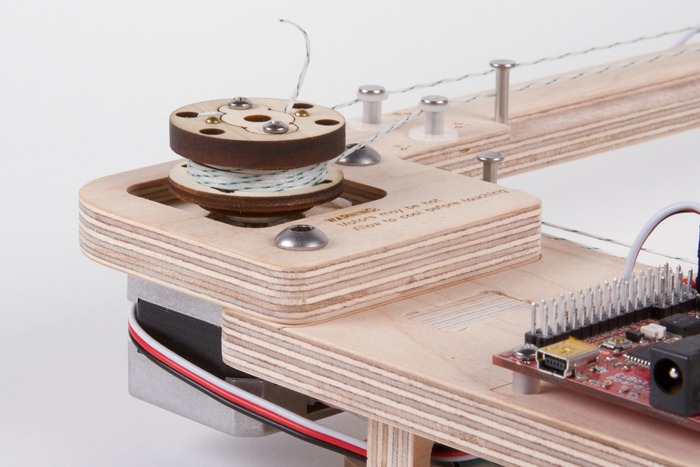
To move the paint brush, there are two motors built into the frame of the robot. Each motor drives a little winch that moves a length of cord attached to a rod that controls either the X or Y position of the brush.
This same mechanism (right down to the winches and cords) can be found inside many vintage plotters and chart recorders. It is also the same mechanism that an Etch-a-Sketch uses, except that instead of a stylus, we have a carriage that moves the brush up and down.
What's in the box?
The WaterColorBot comes as a kit, with some assembly required. It includes the already-built chassis, carriage, and motor controller board. It also comes with a starter set of watercolor paints, paper, and a brush. Please see the FAQ below for a more detailed list of the kit contents.
You will need a recent-vintage computer (say, made within the last five years) with an available USB port. You will also need internet access to download software, instructions, and (optional) instructional videos.
To put the kit together, you'll need small and medium philips-head screwdrivers, and a sharp pair of scissors. Pre-teen and younger kids will need adult help to put it together and get started using it.
History of the project
Sylvia Todd, star of Sylvia's Super-Awesome Maker Show, came up with the idea for the WaterColorBot because she wanted to create an art robot and enter it in the RoboGames competition. She approached us at Evil Mad Scientist Laboratories about collaborating on the project, and we loved it.
Together we designed and built our first prototype in February, and had a nicely-working robot about a month later. As we realized that this project had a lot of appeal beyond just a one-off project, we started developing it into a kit. Sylvia exhibited her prototype at RoboGames (and won a Silver medal), and we also brought the WaterColorBot to Maker Faire, where thousands of people got to play with it.
Sylvia was also invited to the White House Science Fair in April, where she got to demonstrate the WaterColorBot for President Obama (pictures and media coverage here).
Manufacturing the WaterColorBot
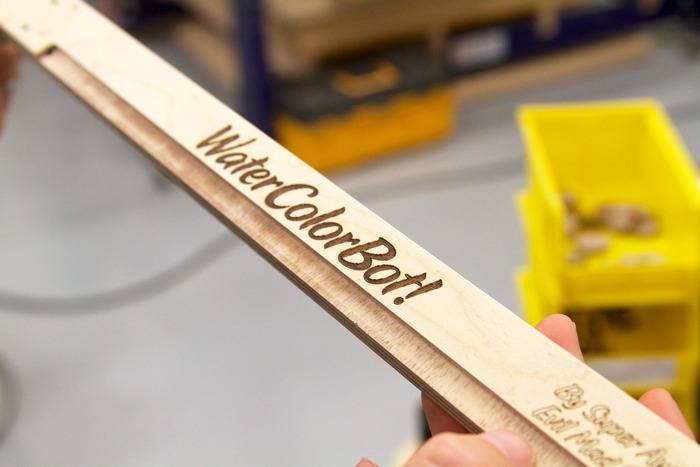
We will be manufacturing the WaterColorBot right here at our shop in Sunnyvale, California. The main chassis of the WaterColorBot is cut from American hardwood plywood using a CNC router, sanded, and finally laser engraved to provide the markings. The carriage and winches are built out of laser-cut wood. We also laser cut and machine Delrin parts, such as the cable guide. The lower "spoilboard" that holds the water, paints, and paper is machined from MDF.
Because we're manufacturing it in-house, we've been able to prototype our manufacturing processes in parallel with the design, every step of the way. We're also building on two years of experience of manufacturing our Ostrich Eggbot kit, which is also made from a combination of CNC routed and laser cut wood and Delrin parts, along with the same motion-control platform that drives the WaterColorBot.
Why Kickstarter?
We're launching the WaterColorBot on Kickstarter for a few different reasons. The most obvious reason is to finance the initial manufacturing run, but more importantly, we are really excited about the WaterColorBot and we want to help it reach as wide of an audience as possible.
Why we're excited about the watercolorbot
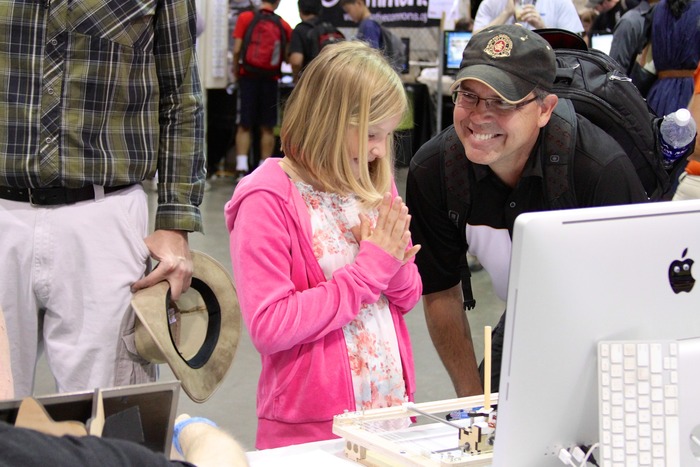
A young visitor plays with the WaterColorBot at Maker Faire
Beyond simple fun, we think that the WaterColorBot has enormous potential for STEM and STEAM education, especially as a way to get young people engaged with hands-on technology and robotics. We are particularly interested finding ways to inspire young women to pursue careers in science and technology. We cannot imagine any better way to do so, than starting with a robot co-designed by a 12 year old girl.
The WaterColorBot is manufacturable and at a late stage of development, so we forsee no overall obstacles to completing the project and shipping our first units. However, our production schedule is ambitious, and could be delayed by parts availability, production time, and other factors.
From our experience manufacturing and shipping thousands of kits (such as our Deluxe Egg-Bot kit) over the past few years, we know about inventory delays, and the havoc that they can wreak upon a project. We mitigate this in a few different ways. First, thanks to Kickstarter, we will know exactly how many machines to build. This allows us to order our parts and materials early, and in the actual quantities needed. Second, most of our parts and materials are common types, for which alternate suppliers are available. Finally, the motion control platform on the WaterColorBot (the motor and controller combination) is the same one that we already use in our Egg-Bot kits, for which we have already established reliable supply chains.
There are other things that could potentially delay shipment-- for example a truly unavoidable chip shortage at the manufacturer level. We will be in close contact with our backers should anything of this nature occur, and will do our best to work around any problems as needed.
We have had the experience of backing projects on Kickstarter, with both stellar and less-than-stellar outcomes. We want to ensure that the WaterColorBot ships on-time, and is a delight to use.
Yellowstone National Park's best-known wolf, beloved by many tourists and valued by scientists who tracked its movements, was shot and killed Thursday outside the park's boundaries, Wyoming wildlife officials reported. The wolf, known as 832F to researchers, was the alpha female of the park's highly visible Lamar Canyon pack and had become so well known that some wildlife watchers referred to her as a "rock star." The animal had been a tourist favorite for most of the past six years. — The New York Times, Dec. 8, 2012
They're intelligent, majestic and, owing to the blood lust of Homo sapiens, never far from extinction. Yet to biologists and ecologists worldwide, the best case for saving wild wolves is their role as predator of some species and, paradoxically, shepherd to others: By stalking abundant elk, moose and other forest browsers, wolves unwittingly enhance the growth of crucial vegetation that gives foxes, beavers, songbirds, pronghorn antelopes and other critters a chance to survive. Today, though, the survival most imminently threatened is that of the American gray wolf itself. Early in June an arm of the Obama administration pleased the politically influential livestock industry — plus hunting interests still smarting over gun control bills — by proposing that the wolves no longer need protection under the Endangered Species Act of 1973.
Until Sept. 11, citizens can submit comments to the U.S. Fish and Wildlife Service. We hope you'll join the fray (details below) and tell the feds how premature and reckless that policy reversal would be: Continuing today's level of protection would give wolves a chance to widen their territories and continue to recover — as bald eagles, alligators, brown pelicans and falcons were allowed to do when they, too, faced obliteration.
Thanks to federal protection that actually dates to the mid-1960s, wolves have begun to rebound from near-extinction — although today they roam less than 5 percent of their ancestors' range. Stripping away that protection likely would freeze in place — and limit forever — this fledgling recovery. Expansion of packs to areas bulging with potential wolf habitat in the Pacific Northwest, California, the Southern Rockies and some Northeastern states would be virtually impossible.
This proposal, if enacted, would free the administration from passionate political clashes between environmentalists and livestock growers in several states. But it also would leave the wolf's recovery not only unfinished, but seriously imperiled: The Center for Biological Diversity, one of many national environmental groups fighting the administration's proposal, says the isolation of too many packs in small, disconnected locales promotes dangerous inbreeding; for lack of genetic variety, wolf litters grow smaller — as do pup survival rates.
Some 2 million gray wolves once roamed North America. By the mid-1900s, though, they had been hunted almost to oblivion in the 48 contiguous United States. A half-century of preservation efforts — federal protections chief among them — have rebuilt that population to about 6,000 in the Upper Midwest and Northern Rockies. Alaska's vast hinterland has another 8,000 or more, living without endangered-species protection. That "lower 48 states" head count, of course, doesn't include the more than 1,000 wolves killed now that Wisconsin, Minnesota, Idaho, Wyoming and Montana have legalized wolf hunting. A group called Keep Michigan Wolves Protected is trying to block hunting scheduled to begin later this year in that state, too.
How can states legalize the hunting of such rare treasures? In a precursor to today's across-the-board proposal, the administration unwisely released those states from federal wolf protection rules in recent years. Some of the killings to date have been barbarous. An Idaho trapper, Josh Bransford, became an Internet pariah after he posed, smiling, in front of a wolf caught in a leg-hold trap; rather than put out of its misery an animal standing in a circle of blood-reddened snow, Bransford used it as his photo prop.
Wolves rarely threaten humans but sometimes do attack livestock: Environmentalists calculate that last year wolves killed 645 of the 7 million cattle and sheep in Montana, Idaho and Wyoming. Ranchers who lose livestock to wolves receive government reimbursements.
That compensation helps balance what can be a good equilibrium. We've noted before that in some states the gray wolf has become a routine and accepted player in humanity's interaction with nature. Other states, though, encounter a familiar collision of two forces: the desire of humans to control what they see as their environment alone, and potential extinction if wolf populations fall so low that disease can exterminate them.
.................................................................................. Care to join the thousands of Americans who already have urged Fish and Wildlife to keep protection of gray wolves intact? Easy: chicagotribune.com/wolf takes you to the appropriate federal website and its blue "Comment Now!" button. Comment now to protect one of America's most ecologically valuable creatures. Comment now in memory of 832F — shot down while wearing the GPS tracking collar that told researchers all about her storied life at Yellowstone.
Wolves nationwide urgently need your help. The U.S. Fish and Wildlife Service is poised to remove protections for these important and majestic animals in most of the lower 48 states, according to a new proposal from the Obama administration.
Since 1973 wolves have been protected under the Endangered Species Act. In 1978 those protections were expanded to include wolves across most of the lower 48 states. In the past two years, protections have been removed for wolves in the northern Rocky Mountains and western Great Lakes. States in these regions have instituted aggressive hunting and trapping seasons resulting in more than 1,600 wolf deaths.
Despite the horror that state management has been, the Service has now proposed removing wolf protections in the remainder of the lower 48 states. The plan abandons wolf recovery in the Pacific Northwest, southern Rocky Mountains, Northeast, California and other areas where there is space for wolves -- keeping protections only for the very small population of Mexican gray wolves that roams Arizona and New Mexico.
Please take action now to lend your voice to the fight to protect wolves. Use the form below to ask Fish and Wildlife to reject this highly destructive, premature plan abandoning wolves across the American landscape.
Here are the facts: - 1 in 4 women has experienced domestic violence in her lifetime. - Nearly 3 out of 4 Americans personally know someone who is or has been a victim of domestic violence. - On average, more than three women and one man are murdered by their intimate partners in this country every day. http://www.cutmovie.co.uk In the U.S., you can learn more and donate to RAINN and like them on Facebook. In the U.K., you can learn more and donate to Women's Aid and like them on Facebook.
In the U.S., you can call the RAINN National sexual assault hotline: 1.800.656.4673
Lastly, if you want to help bring more awareness to this, you could share this. It's your call, though.









 ..................................................................................


